Transition curve
A transition curve is not the primary control element that defines the route. It is a connecting element placed between controlling tangents, arcs, or other alignment units. A tangent has zero curvature, a circular arc has constant curvature 1/R, and the transition curve changes curvature continuously between them.
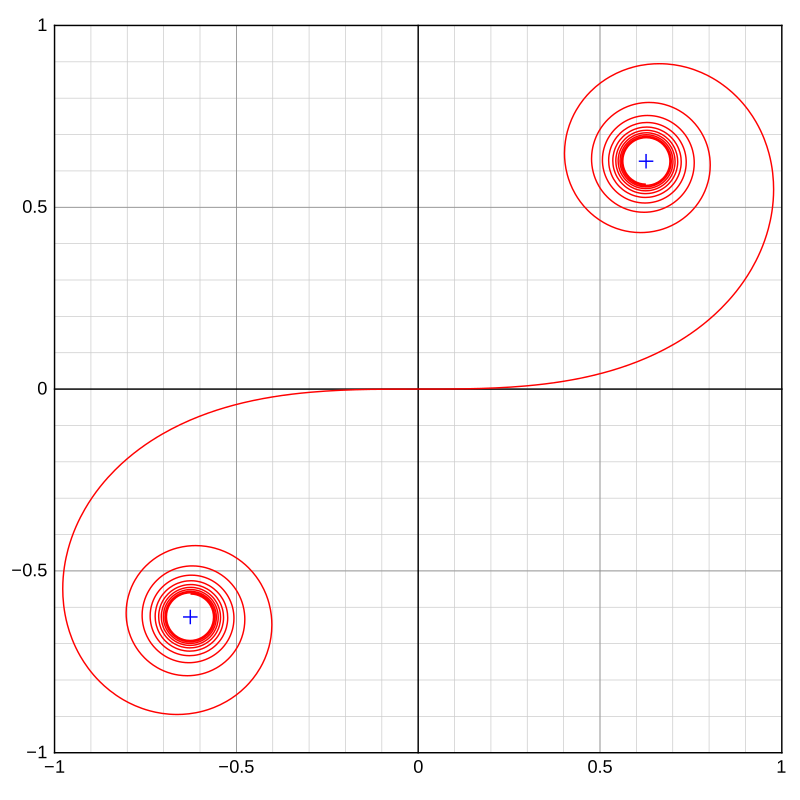
Image source: Euler spiral.svg by Jheald, CC BY-SA 3.0, used here as a geometric reference for transition curves.
When editing a horizontal alignment, think of tangents and arcs as the control skeleton: they decide direction, position, and radius. The transition curve is the smooth connector generated between them. If the skeleton is placed well, the generated connector will also feel natural to drive.


These two curvature diagrams show the advantage directly: without a transition curve, curvature jumps from 0 to 1/R at the tangent-arc join. With a transition curve, curvature grows gradually through the transition before reaching the circular-arc curvature, making steering and lateral acceleration smoother.
A^2 = R x LA common clothoid relationship. A is the transition parameter, R is the circular radius, and L is the transition length. Project values should be checked against the applicable design standard.| Principle | How to read it | What goes wrong if ignored |
|---|---|---|
| Control elements must be separated | Leave real space between the tangent and arc for the transition curve; they should not intersect, overlap, or already touch | Transition length collapses toward zero, causing curvature jumps, foldbacks, or crossing geometry |
| Original elements need enough length | A transition curve consumes part of the adjacent tangent or arc, so the original element is shortened after generation | If the original element is too short, the transition may cut too deeply, remove the arc, leave a tiny tangent, or break the intended combination |
| Connection directions must agree | The transition should leave the previous element in its forward direction and enter the next element in its forward direction | The alignment forms a corner or hairpin-like kink that requires instant steering correction |
| Curvature should change monotonically | Tangent-to-arc usually changes from 0 to 1/R; arc-to-arc changes between two circular curvatures | The vehicle may sway unnaturally if curvature grows and shrinks within the same transition |
| Radius and length must match | Smaller radii and higher speeds usually need longer transition length to spread lateral acceleration change | A very short transition may connect geometrically but still feel harsh to drive |
| Do not mix left and right turns in one simple transition | A left arc to right arc should be treated as a reverse-curve combination | A tight S curve can force lateral acceleration to reverse too quickly |
The table places each common combination next to its corresponding diagram. Blue marks the controlling arc or original element, while magenta marks the generated transition alignment.
| Combination | Diagram | Recommended connection | How to picture it |
|---|---|---|---|
| Tangent - arc - tangent | — | A basic complete curve: entry transition + circular arc + exit transition | The arc controls turn radius while both transitions control comfort |
| Tangent - arc | 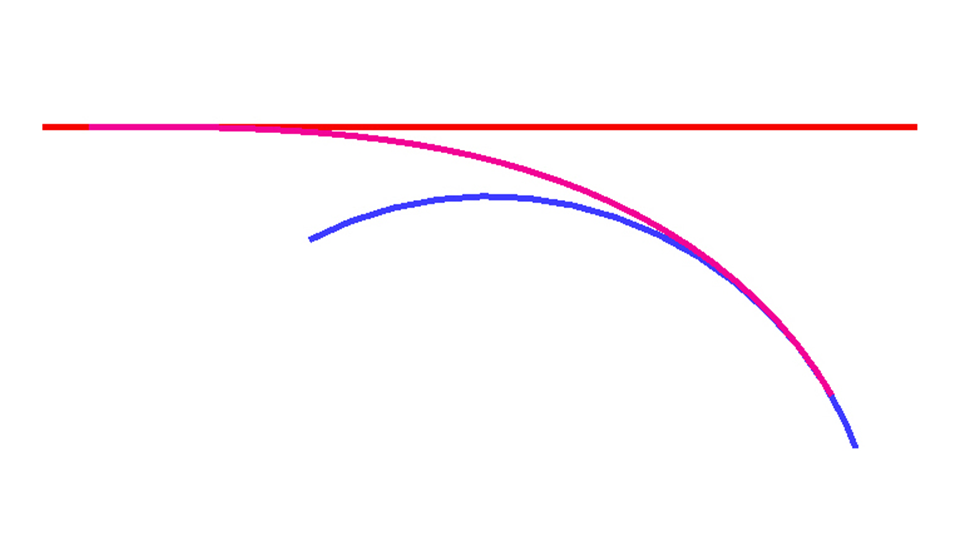 | Connect with one transition curve; curvature changes from 0 to 1/R | The tangent is straight, the arc is the target turn, and the transition is the gradual steering input between them |
| Same-direction arc - same-direction arc | 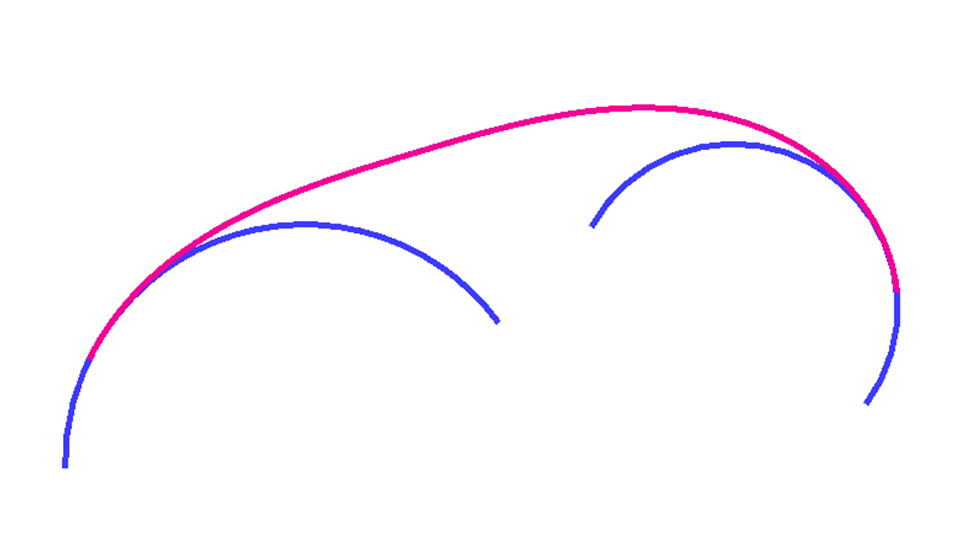 | Use a transition between two different radii; curvature changes from 1/R1 to 1/R2 | The curve gradually tightens or opens up, as in a compound curve |
| Reverse arc - reverse arc | 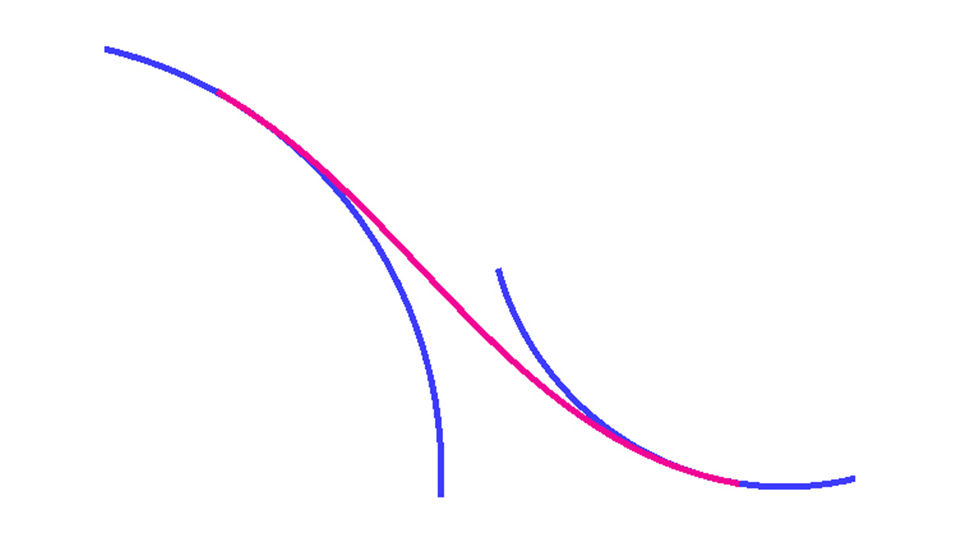 | Treat as an S-shaped reverse curve and leave enough separation; add a short tangent or longer transitions when needed | Lateral acceleration changes direction, so tight spacing is the usual source of discomfort |
| Check | Good behavior | Typical issue |
|---|---|---|
| Geometry | Control tangents and arcs are separated, with enough original length for the transition to consume | Elements intersect, overlap, touch, or are too short to leave transition length |
| Curvature | Curvature changes continuously in a clear direction with no kink | Sudden steering at arc entry, or curvature oscillation |
| Turn direction | Left and right turns are clear; reverse curves have enough transition space | An S curve is too tight and lateral acceleration reverses too quickly |
| Superelevation | Cross slope changes gradually along the transition | Cross slope changes too quickly or the wrong way |
| Driving test | Smooth steering input and natural yaw change | Yaw, shaking, or instability at speed |